Friday, January 8, 2021

Yvette Harrell's Vote Against State's Rights

 I received this email yesterday, as did many other voters in CD2, offering an explanation for Harrell's support of a preposterous last-minute move in Congress on behalf of President Trump which contributed in no small part to the violent insult to democracy that occurred in the Capitol in Washington on Wednesday.  Normally I wouldn't bother to reply; congresspersons frequently make foolish decisions, many of which should be forgiven in consideration of Potomac fever and, now, the coronavirus blues.  But since the stakes are very high, I am including a copy of her email and my reply.

Late last night, I kept my promise to object to the certification of the Electoral College tallies from the two states for   which votes were permitted: Arizona and Pennsylvania. No other objections for any other state, including New Mexico, had the required backing of at least one U.S. Senator that would have allowed a vote on the House floor.
The unconstitutional election changes in numerous states disenfranchised my constituents in New Mexico. I hope that by joining so many of my House colleagues in objecting we can shed light on the problems with the 2020 election and move towards solutions that restore integrity and confidence to our electoral system.

As President Trump said this morning, there will be an orderly transition to the new administration on January 20th. I  will continue to work on behalf of the people of New Mexico's Second District to support our shared values of limited government, free markets, and Constitutional rights.
 
My reply:
 
Your explanation is unacceptable.  You pay lip service to limited government and markets and constitutional rights, but your actions have violated the Constitutional mandate for states to determine the outcome of their own elections.  Your assertion that electoral actions in other states (which you feel expert enough to deem unconstitutional) "disenfranchised my constituents in New Mexico," is just gibberish.
 
You took it on yourself to use your position as a congresswoman from New Mexico to stick your nose in Arizona's business and Pennsylvania's.  How would you like it if Chuck Schumer objected to your victory at the polls last November, and was able to use his clout two weeks from now to get half the Senate to publicly cast doubt on the legitimacy of your standing as a congresswoman, based, let us imagine, on rumors from progressive leaders in New Mexico, that you rigged some of the votes in Doña Ana County, in spite of sworn testimony from the relevant officials (Democrats and Republicans alike) that the votes were counted faithfully and accurately?
 
When you were in the NM House I asked Mary Kay Papen to offer me her opinion of your character, and her positive response caused me to respect your judgments.  Same thing with Harvey Yates.  That respect has ended.  You are now complicit in this assault--including the shameful events at the Capitol last Wednesday--on the rule of law, which is the foundation of our democracy.

Thursday, January 7, 2021

Don't Expect Calls to Action from Nancy or Chuck:  They should step up, but don't expect it

Their Silence Suggests Democrats Need New Leadership in Congress

It is well past 12 noon in Washington on January 7 and we haven't heard anything from Pelosi or Schumer about impeachment.  I don't expect it.  After four years of wringing their hands at the "dreadful" actions of the President, including treason, illegal financial actions, racist actions implemented as policy, atrocities on the US-Mexico border, etc., but taking no actions, this is unlikely to change, even in the face of the violent insult to the American creed we witnessed yesterday.  The public is far ahead of our political leaders today.

Nancy had to be dragged into an impeachment process against her will last year, and only after everyone who had access to a television broadcast had heard the damning evidence multiple times and the general public was insisting on national leadership in the face of treason.  And, of course, Nancy understood that McConnell would treat impeachment as an insult to his intelligence. There was no cost, no risk, in going through the motions.  It even gave congresspersons a chance for free television face time, and then we could go back to pretending our political system remained normal, and hoping voters would bail them out even as enemies of democracy, abroad and at home, were plotting to make a shambles out of our elections.Everything she did was tactically correct but morally without compass.

Chuck and Nancy have been safely re-elected to their leadership positions under a Biden administration, and they can't wait to get back to the minute but passionless details of complicated legislation, responding to the special interest needs of their legislative followers and negotiating with the other side behind closed doors.  The tragedy of American politics, the ICU condition of American democracy, yesterday in full naked view, it would seem, are mere distractions for them to the art of legislative negotiation.

Sometimes this kind of leadership is desirable.  It works well when you have both parties pretty much in agreement about the major contours of the public agenda, and you need knowledgeable specialists to hammer out the messy sausage of legislation everyone will be reasonably happy with.  That was long ago, from about the mid-1980s until the 20-teens, when neo-liberalism was an umbrella, however skewed toward the rich, everyone who needed campaign contributions could live with in bipartisan happiness.

But when the agreement is gone, and brute force, legal or illegal, becomes the currency of the land, it is time for a switch to a different kind of leadership--one with a passion for making things right, one that instinctively fights back to protect the common good against foes who have the needed passion to destroy what it has taken centuries to build.  Twenty four hours later, I don't see that person emerging in the Democratic Party.  The Republican Party is probably too shell-shocked, heading for cover, to do much more than slough off  their wounds with soundbites written by professional spinners.  Do not trust the leadership of either party in Congress with your democracy.  They have already failed to protect it.

Expect the political system to shift attention to a celebration of the triumph of democracy in the coming swearing in; to shift attention to investigations of security system reform at the Capitol, to analyze the profiles of ringleaders of the mob, to reveal legislative priorities for the new administration.  We need a new generation of leaders to fix a broken system.  Right now we have more of the same.

Wednesday, January 6, 2021

 Do the US Constitution's Provisions for Impeachment Imply a Bottom Line?

Does Article 25 of the Amendment to the Constitution Have a Bottom Line?

Does Congress Have a Bottom Line?  Do Nancy and Chuck and Mitch Have Bottom Lines?

Do We the People Have a Bottom Line?  Do You Have A Bottom Line?

Until recently the attack from Trumpolandia was against the hypocrisies of our political system.  Agree or disagree with the specifics, reasonable people have been persuaded for four years that perhaps our institutions needed a shake-up; if you didn't like it the remedy was the electoral process in 2020.  But we were warned from the beginning that attack was also against the the core machinery of democracy, and possibly against a true count of the votes in 2020.

Today the attack was not just an act of disrespect against the institutions of our government, and against the election machinery which forms the rock-bottom core of our system.  It was an assault on the physical home, and the ceremonial actions of democracy taking place at that moment within that home, which holds the chalice of our experience as Americans.  The breach was seen around the world.  The insult could not be more naked or more pointed.

Monday, January 4, 2021

None Dare Call it Treason

In 1964 a book called None Dare Call it Treason was self-published and widely distributed in bulk, often for free, repeating a right-wing wacko conspiracy fairy tale about the federal government being infiltrated by communists.  Among the malicious absurdities of this fairy tale was this line: "Amazingly, the fortunes of America’s most successful tycoons...have been redirected to finance the socialization of the United States.”

The fairy tale had been taken up in 1949 by Senator Joseph McCarthy and used with no evidence to destroy the careers of many loyal foreign service officers, apparently in an effort to spread hatred and fear among vulnerable sectors of the electorate.  Senator Margaret Chase Smith, a Republican from Maine, was the first Senator to take McCarthy on, in 1950.  "I don't want to see the Republican Party ride to political victory on the four horsemen of calumny—fear, ignorance, bigotry, and smear," she said.  Democrats in the Senate and elsewhere, while complaining in private, refused to take McCarthy on in public, cringing with fear at the notion they might be accused by McCarthy of being fellow-travelers.  President Eisenhower was not happy with McCarthy but there was little he could do and McCarthy continued spewing lies until he died of liver failure aggravated by alcoholism in 1957.

There is a Trump connection here.  Roy Cohn was McCarthy's attorney.  Cohn was a truly malicious man who ended up being disbarred in 1986 for pressuring a dying client to change his will naming him a beneficiary.  He was McCarthy's lawyer in the 1950s at hearings where unfounded allegations were launched.  He represented several mobster bosses.  He was a friend of Roger Stone and represented Rupert Murdoch.  He also represented Donald Trump, and mentored Donald Trump in the art of  malicious trickery, defending him in a lawsuit by the federal government for discriminating against African Americans in 39 of Trump's properties in Manhattan.  Throughout Cohn's career there were accusations of theft, obstruction, bribery, blackmail, fraud, perjury, and witness tampering.  Sound familiar?  The gang of thugs surrounding our outgoing President didn't begin with Trump's election:  They had been practicing their trade, conniving on the fringes of legality for decades, and only the permissiveness of the conservative movement toward their own unscrupulous allies allowed them to maintain a shaky respectability. 

The title of the book None Dare Call it Treason was taken from a political poem written in the late 1500s by a British writer in the court of Elizabeth I. The relevant line is, Treason doth never prosper? What's the reason?  For if it prosper, none dare call it treason.  Ponder that line for a moment.

This past weekend, the President committed another serious criminal act that should elicit immediate removal from office as well as jail time. Once again scoundrels in the US Senate are protecting him, as might be expected.  What is even more alarming, however, for the long-term prospects for American democracy, is the cowardice in the US House of Representatives, led by an autocrat from San Francisco.  

As the President's already-infamous hour-long recorded criminal phone call to an election official, asking him to "find" votes, was being broadcast 24/7 throughout the media world this weekend, the House of Representatives was too busy to respond, preoccupied as it was with the ceremonial niceties of re-electing the president of the club, Nancy Pelosi, to another term as Speaker.  And Nancy, whose national approval rating at one point in 2020 stood at 14%, is well known for her autocratic refusal to allow the people's chamber to take action against the criminal actions of the President. (Isn't "autocratic" the term many Democrats use to characterize Mitch McConnell's use of power?) She had to be dragged into holding a vote for impeachment after universal demand for it following proof the President had offered to bribe a foreign official for his own political benefit.  Her rationale for not taking action until then (gobbledigook about "strategy") was even less intelligible than the laughable rationale offered by an obviously frightened Senator Susan Collins for not voting to impeach the President:  "I think he has learned his lesson."

The rabbit hole of Alice and Wonderland leads to a topsy-turvy world.  Two female Senators from Maine:  one stood up courageously against malicious mischief; seventy years later another cowered in fear.  The same movement that created the fairy tale of treason during the 1950s protects the undeniable reality of treason from the President in 2020, while those elected officials sworn to protect us against threats to the Constitution cringe in fear.  Members of the most democratic institution in the United States ignore the signs of a failing democracy, refusing to place the T-word where it belongs.  House members seem content to cross their fingers, close their eyes, hiding behind the skirts of their leader, hoping for the best against all odds while doing nothing--except wringing their hands--to prevent further damage in the next three weeks.  Do you trust these people with your democracy?

Democracies fall this way.  I spent four decades observing democracies rise and fall in Latin America.  This is nothing new.  Seventy seven years ago Robinson Jeffers offered this line, contemplating the end of American democracy:  Our men will curse, cringe, obey; our women uncover themselves to the grinning victors for bits of chocolate. (We Are Those People)

Monday, December 28, 2020

 Part II:  How to Restore Majority Rule in New Mexico

In Part I the drift toward extremist tendencies in our political system were reviewed, emphasizing the importance of redistricting, which, as it has been pursued, has made it possible for minority views in each party to win in primary elections without penalties as districts are increasingly "safe" for members of one of the two parties.

Unlike most solutions, this one is quite simple, requiring only two steps:

Step One:  Place redistricting in the hands of a non-compromised blue ribbon, bipartisan commission.  This has been done in several states, including California.  Both political parties have shown themselves completely irresponsible in redistricting plans, so much so that virtually all redistricting plans have been contested and often resolved in court.  Ultimately, legislatures are constitutionally mandated to pass a redistricting plan, but this doesn't mean legislators must involve themselves in the details of redistricting.

Step Two:  Instruct the commission to maximize partisan competition in as many districts as possible.  The more nervous a legislator feels about losing to the other party next time around, the more likely the legislator will be striving for bipartisan solutions in legislation.  Bipartisan solutions, as Part I demonstrated, are moderate solutions, and moderate solutions is what most voters want.

These two steps will not solve all of the problems in our deeply flawed political system, but they will definitely create a strong incentive for individual legislators to seek common ground, which is in the middle of the political spectrum, not on the minority tail-ends.  These steps will also go a long way toward creating a more civil tone to political discourse in New Mexico.

Monday, December 21, 2020

Part I:  How Our Major Parties Have Shut Out Majority Rule

(Note:  This analysis is technical, but not overly so, and worth knowing.  Stay Tuned for Part II:  How to Fix the Anti-Democratic Trend in American Politics.

As computing technology has improved over the past few decades, the two major political parties have colluded, often tacitly, to make US congressional and state legislative seats less competitive between the two parties.  The mischief occurs during redistricting, mandated every ten years. Legislative redistricting has always resulted in gerrymandering, and courts have often intervened to put guardrails against gerrymandering against a minority group or political party.  But, just as is the case with corporate monopolies, courts have failed to intervene to halt collusion to reduce inter-party competition within legislative districts at the statewide level.  Today software can reduce party competition within districts to the satisfaction of Democrats and Republicans alike, and unsurprisingly, both parties and individual legislators revel in the practice.  This has had powerful anti-democratic consequences for the entire political system, paving the way for the unprecedented attack on our democratic institutions during the Trump Administration.  Most American abhor these trends but because both parties are complicit in them, you seldom hear about it.  This needs fixing.  Here's why.

The collusion game is simple.  Most legislatures engage directly in their own redistricting, a serious conflict of personal and partisan interest in a matter that should favor the public interest.  If as a Democratic legislator I wish to improve my chances of winning my seat after redistricting, this will happen if precincts that trend Republican in my district are removed, replaced by precincts that trend toward Democrats.  A Republican in an adjoining district will be happy to shed her bad (Democratic) precincts in return for acquiring good (Republican) precincts in return.  Net result:  we are both happy and more likely to get re-elected.  Notice that both parties have an equal interest in doing this for the entire state, since members of both parties, as a whole, are likely to be better off, and few will be much worse off than before.  As in musical chairs, a few legislators may be stranded unhappily, as an incumbent may be squeezed in the interests of protecting the entire majority party.  But over time it has been well documented that most legislative districts have become less competitive.

What's wrong with this?  A lot.

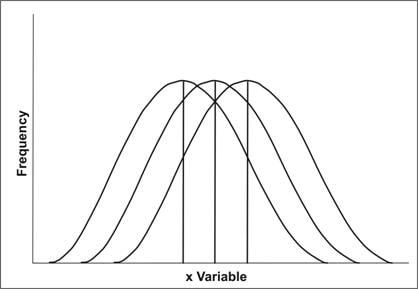
Imagine an electorate composed of people of all kinds of political views, ranging from the extreme left (Commie Pinkos) to the extreme right (Fascist Pigs).  If you count people according to their political views along a two dimensional spectrum from Left to Right you will find that in each district there are only a few Commie Pinkos and Fascist Pigs.  Most people are more moderate.  In fact most people cluster rather close to the middle of the spectrum.  Shown visually, this looks like a bell-shaped curve.  As you can see in the diagram below moderate views form the majority of the electorate.  


Of course, a person considered "moderate" in Hobbs would be considered a Piggie in Santa Fe, and a "moderate" voter in Santa Fe would be considered a Pinko in Hobbs. But in each district you are likely to find a bell-chaped curve of preferences even though the center point in the curve may vary from district to district.
Principles of Epidemiology | Lesson 2 - Section 4

 In the illustration above, assume that the bell-shaped curve on the right represents the distribution of preferences within the Republican Party, and the one on the left represents the distribution in the Democratic Party; that is, most Republicans are more to the Right and the Democratic Party is more to the Left than the average voter, represented by the bell-shaped curve in the middle.  Since primary elections determine candidate selection, one would expect the winner of the Republican primary to have pitched her message toward the middle of the right curve (the vertical line to the right), the Democrat toward the left curve:  that's where most of the votes are in each respective district.  But after the primary election you would expect each candidate to retreat toward the middle of the middle curve, where you find most voters.  The winner's voting record in the next election would probably lie closer to the middle of the middle than to the middle of her party's center because moving too far from the center would leave the winner vulnerable to attack by a more moderate opponent.  Fifty years ago this pattern of shifting back to the middle after the primary was the rule, not the exception, and moderate policies were the overall result. The system as a whole favored bipartisan, competent, government.policy, and voters tended to be reasonably happy with the direction of the country regardless of which party was in power.

The Move Away From Majority Rule

As districts became less competitive due to collusion between both parties during redistricting, the rule of moderation began to collapse. If my district is more heavily Republican after redistricting, as a Republican I don't have to worry as much about pleasing Democratic voters as I look toward the next election.  I'm likely to win without them and, should I try to please them I risk being challenged in the next primary by a more conservative Republican.  My incentive to compromise is lessened while my incentive to be "pure" to conservative causes is increased.  Many negative consequences ensued from this, including:

  •  Both political parties began moving away from each other despite there being no change in the preferences of voters! That is to say, both parties became less democratic.
  • Legislators representing the tail ends of the each distribution--the commies and the pinkos--began getting elected--something almost unheard of fifty years ago. 
  • Norms of civility in legislatures were broken as legislators paid fewer costs for screaming insults at the other side of the aisle.When moderates tried to instill more calm they were often shouted down by extremists on both sides.
  •  In each party moderate majorities found themselves outflanked by the pinkos on the Left and the piggies on the Right.  This often led to legislative paralysis, as in the case of the US Congress, when the Senate and House were controlled by different parties.  If your seat is safe, there is no prize for compromise, and over time, compromise even becomes a bad word.
  • As these trends deepened, the rewards for a legislator to be a true believer to causes ever-more extreme came to outweigh the rewards for a legislator to insist on competent, non-partisan government.  This tendency reached outrageous levels during the Trump Administration, which flaunted the lack of experience of top administrators and ignored the policy wishes of the vast majority.
  • Because of the winner-take-all character of our election system, added to the tendencies in both parties toward the extremes, policy is increasingly divorced from the wishes of the majority:  better education, affordable health care, reasonable gun laws, less crony socialism for the rich, etc.  The last two Republicans to occupy the White House were each elected with fewer votes than their opponent.  Politicians have found is is easier to mobilize the increasingly radical "base" for re-election by insulting the other side than it is to do the hard work required to pass legislation the public wants.
  • The net result of all of this has been a highly polarized political system, with less compromise, in which loud, aggressive minority groups outshout the majority, and in which minority views become overly represented in legislatures.  The news media incorrectly tells us the electorate has become more polarized (how many times have you heard the term "deeply divided electorate?" or "tribalism?") when in fact,  electioneering practices have compartmentalized legislative districts such that moderate voters--the majority of voters-- have become increasingly disenfranchised as a result of electioneering practices that have deeply undermined the democratic foundations of the country and left most voters dissatisfied with both parties.

Voters should be suspicious of any trends in the machinery of politics that have the effect of disenfranchising the majority of voters in one district, let alone across the country. While New Mexico has been spared the worse excesses of these anti-democratic trends, they have definitely left their mark on the state.Key position in the leadership of both parties have now been captured by groups representing a minority of voters in their own parties.  This year alone, two persons falling into the "pinko" side of the curve teamed up in a successful attack against two fellow Democrats, each of them among the most outstanding legislators of the past half century--Mary Kay Papen and John A. Smith.  Both of them faithfully represented the majority of voters in their districts and in the state, who would fall into the middle-middle part of the curve.  These pinkos also succeeded in ousting one of the most promising state Senators in recent times, Clemente Sanchez, attacking him for voicing the concerns of the majority of his district and the state. In the Republican Party a politician from Hobbs was re-elected party chair last week.  He proved unable--twice--to win a statewide election due to his political views, which may fit Hobbs, but certainly don't represent the views and aspirations of the average Republican voter, much less the views of the average New Mexican.  These are not good signs for the democratic health of the state.

Monday, December 7, 2020

 New Mexico Politics As the Post-Trump Era Begins:  The View from Southern New Mexico

Three elements to keep in mind as the holidays beckon, the pandemic surges throughout NM, and a new president takes office in January:

1.  New Mexico continues to be polarized between Democrats in most of the North and Republicans in most of the South.  Statewide, Democrats continue having an edge but.....read on.

Biden beat Trump in NM by 100,000 votes out of about 900,000 votes cast--a gap of nearly 11%, not quite a landslide, but close.  Hillary won New Mexico in 2016 by only 8%, with only 700,000 votes cast, so the overall verdict on Trump in NM this year was negative.  However, Trump got about 80,000 more votes in 2020 than he did in 2016; Biden got about 115,000 more votes than Hillary.  Both the House and the Senate continue easily under Democratic control--more about this below.

Normal North-South partisan polarization in New Mexico in 2020 is evident in the Biden-Trump numbers:  In the North (18 counties) Biden got 60.5% of the vote, but only 41.7% of the vote (15 counties) in the South.  And without the huge numbers in Doña Ana County the vote for Biden in the South would have dropped from 42% to 33%.  (But remember that Doña Ana County is not AOC country.  Hillary beat Bernie in the 2016 primary here by whopping 56%-44%.  This is relevant to a point I will make below)

Democrats cannot take the sunny weather for granted.  Republicans have occupied the governor's mansion for fully16 of the past 26 years, and were able to control the NM House for two years during the Martinez administration, for the first time since the 1950s.  The only two Democratic US Representatives elected from the South since 1978 (Harry Teague and Xochitl Torres Small) each lasted only one term before being replaced by Republicans.

2.  The Pandemic and State Government:  Toast in Twenty Two?

After the disasters of the Trump mal-administration, voters may be more inclined to judge elected officials on their ability to govern well, rather than to spout rehearsed or defiant nonsense.  This puts pressure on the Governor's performance next year, given lackluster results so far.  Like Bill and Susana before her, the lure of Washington occupied too much of her time  After getting off to a classy start earlier this year, lately the governor appears to have been winging it.  In spite of outstanding talent at the NM Dept. of Health Michelle's recent decision-making about covid 19 seems strangely off-base.  At the moment NM is in the embarrassing position of running out of hospital beds as people with possible symptoms struggle to negotiate an inadequate, crazy-quilt testing regime--while the administration bickers endlessly with the Restaurant Association about miniscule details of opening and re-opening. The test of leadership is how well you handle the crises.  If the governor is unable efficiently to deliver vaccines and other pandemic assistance throughout the state--and begin to articulate a coherent approach to our many critical problems for the next five years--she could end up toast in '22 should someone serious decide to run against her.  In order for this to happen, however, the Republican Party of New Mexico would have to prove that it still believes in republicanism as opposed to crass tyrannical rule.  The test of leadership is how well you handle the crises.  At the moment the state Republican Party is paralyzed, apoplectic, unable to respond to the critical conditions of the state or to imagine the possibilities inherent in the messes before us.  It has forgotten that politics is about governing.  More about this in future postings.

3.  Most New Mexicans are More Moderate than Partisan.  The political balance of power among Democrats within the legislature this year shifted decisively to the North and away from moderation. This may set in motion powerful forces we've seen play out before.

The liberal wing of the Democratic Party in the North, led by Eric Griego and Paul Gibson, indulged in the mischief of unseating fellow Democrats in key Senate primary elections in the South.  The ostensible motive was to make the Senate more responsive to progressive legislation, but the outcome was to shift political power from the South to the North, and to weaken the party's appeal to the average New Mexico voter who for many decades has proven to be decisively in the moderate camp.  In 2021 the Democratic Party will no longer have bragging rights for harboring three of the strongest champions of moderation--Senators Mary Kay Papen, Senator John Smith, and Senator Clemente Sanchez--to keep both parties in check.  They were replaced by inexperienced persons now beholden to their out-of-district funders.

Each political party in New Mexico forgets to its own peril that the state is overwhelmingly moderate.  We've seen this movie before.  When Walter Martinez, Speaker of the House in 1977 engaged in the mischief of dis-empowering moderate-to-conservative Democratic legislators from the South, he was ousted as Speaker in 1979 by a coalition of moderate Democrats and Republicans.  Within a decade, the entire East Side of the state had switched party allegiances, and voter registrations, and today it is the center of gravity of conservative Republicans in New Mexico.

The middle-finger insult Griego and Gibson threw at moderate New Mexican voters throughout the state may come back to haunt the Democratic Party at the statewide level should moderate Democrats in the Southwest conclude, like their counterparts to the East long ago, that party loyalty will be abandoned when loyalty demands turning your back on the will of your constituents.  Gibson and Griego are outraged about recent national Republican willingness to indulge in blatantly anti-democratic practices.  But who are they to complain?  The balance of power held in the South until now was legitimately earned by senators who held the line of moderation against the extremes of both sides--just what most voters in New Mexico wanted.  By playing dirty tricks against three powerful moderates who represented their Southwestern districts faithfully, they have effectively disenfranchised hundreds of thousands of voters throughout the state--just the kind of blatant anti-democratic behavior they piously attack at the national level and that lost the Southeast of NM to the Republican Party long ago.   Will forces to counter this insult to moderation and democratic practice gin up to do something about it?  Veremos.

Friday, April 17, 2020

US-Mexico Border Update for Paso del Norte Region
Native Americans Hardest Hit in New Mexico

                         Pop          Cases       Tests        Deaths
New Mexico     2.1m        1,597        34,488        44
DAC                   218k          58           2,653           1
Texas                27.4m      17,371    169,536*     398
El Paso Cty         840k           451        1,499**       7
Chihuahua         3.6m            128           605***   24
Cd. Juarez         1.3m              88          N/A         22

New Mexico Covid-19 Cases by Ethnicity:  Native Americans:  37%; Hispano:  24.5%; Anglo:  21.4%

*includes extensive testing by private labs
**Through April 8
***Implied in data provided; probably does not include private testing

Making Sense Out of the Data:

1.  New Mexico is still way out in front of Texas in testing, although Texas is catching up, using mainly private labs.  On April 3 NM was testing 3.5 times more people per capita than Texas, but now the gap has shrunk to 2.6 times.  
2.  Testing in Chihuahua and Juarez lags far behind NM and Tx,   With data showing only about 605 tests in Chihuahua, it is far from clear that the 128 cases in Chihuahua is an accurate picture of what is happening there.  Surely Juarez and Chihuahua state have far more cases than those being reported.
3.  The lag in testing between NM and Texas shows up dramatically in the data coming from El Paso County and Dona Ana County.  The data on testing  from El Paso is a week behind (April 8) New Mexico's,  but as of then Dona Ana County was testing 9 times more persons per capita than El Paso County.  This suggests that the 451 reported cases in El Paso may be lower than the actual number.
4.  Dona Ana County has not been tested as thoroughly as New Mexico, but appears to be catching up.  Statewide 1.64% of all persons have been tested, in Dona Ana the corresponding number is 1.2%.
5.  Native Americans in New Mexico form only about 11% of the population, but have 37% of the cases, so far.  It may be that Native Americans, especially in the Northwest, have peaked early in infection rates, and may not in the end provide 37% of the total number of victims statewide.  Expect the ethnic distribution of cases to change as the virus spreads to other parts of the state.

Friday, April 3, 2020

Paso del Norte Coronavirus Positive Cases as of April 3

Area                   Population             Source (cases)              No. of cases        No. of tests

NM:                        2.1 million                Source                      403 cases          14,778 tests
Dona Ana Cty            218,000                Source                        21 cases                  N/A
Texas:                  27.4 million                 Source                    4669 cases           50,679 tests
El Paso                       683,000                Source                        78 cases                415 tests
Chih:                     3.6 million                  Source                        11 cases                 84 tests
Juarez                    1.3 million                 Source                          7 cases                   N/A

Making Sense Out of the Data:

1.  The amount of testing per capita varies wildly from place to place.   New Mexico leads all states in per capita testing, closing in on one percent of the total population.  This is about 3.5 times more testing per capita than Texas, and about 300 times greater than per capita testing in Chihuahua.  

2.  The numbers above don't reflect the reality on the ground.  At first glance it would appear that El Paso and Juarez have not yet been infected seriously, and that New Mexico is ahead of El Paso in the number of cases.  However, if you factor in the difference in testing, since Juarez and El Paso have not been testing as much as New Mexico, they can't know how widespread the contamination has reached.  With $110 billion dollars worth of goods being shipped across four bridges in the Paso del Norte region each year--the busiest border in the world except for the California-Mexico border, it seems likely that infections are higher than the numbers would imply.  One trucker, crossing the border at Santa Teresa, showing no symptoms but contagious, could have infected someone without knowing it.  Where did this trucker spend the night?  Where did s/he eat?  Where did he get gas--at theVado filling station or in Anthony?

Watch newspaper reports about what is happening in hospitals.

Thursday, April 2, 2020

Opinion:  Mexico Debates Bailouts for Companies

Note:  Economic policy in the US last week was unusually bipartisan as the US government added two trillion dollars to its existing $6 trillion debt load, hoping to bolster the economy during the unprecedented economic calamity of the coronavirus crisis.

How is Mexico handling the economic fallout from the crisis?

 The debate over fiscal policy in Mexico is just beginning.  The path has not yet been chosen, but as it unfolds it will, more than the sycophantic behavior, determine what historians say about Armando Manuel Lopez Obrador.

Mexico is currently in its most me-too moment vis a vis the United States since the Revolution began over a century ago, and this holds for Mexican culture as well as for trade relations and Trumpian soundbites about national coronavirus health policy.  Consequential decisions must be made now.
 Pull the Plug on Most Maquilas in Chihuahua?
Tough Calls Are Headed This Way, Very Soon 

In Diario de Juarez today:  (click here)  Mexican law, published last week on March 27, decrees that from now until April 30, manufacturing plants can stay open only if they produce consumer goods, medical equipment, medical technology, or deal with the disposal of infectious diseases.

Three hundred thousand workers--out of a workforce of 450,000--in Juarez work in the manufacturing sector, virtually all of it in the maquila plants.  It is the backbone of the economy in Northern Chihuahua.  Only 39 plants out of 329 manufacture medical supplies.  You cannot stay at home on a laptop and assemble a computer or refrigerator.  The head of the Maquila plant association, Pedro Chavira, estimates that this implies releasing around 264,000 workers from work for (at least) four weeks.

Some sort of negotiation, said Chavira, must take place with these firms to find something that will benefit everyone during this situation.  "What we don't want to do, and it won't happen, is to send these people to their homes with no money." 

Some plants, perhaps as many as 20, have already ceased operations. especially in the auto parts industry, due to a lack of demand as auto makers in the US have already shut their doors.

Each worker in the manufacturing sector, on average, according to Chavira, produces about $1000 in goods.  This implies a loss, he says of up to $34 million (US) each day.

Question:  if the average worker contributes $1000 (US) per day in production value, how much does each get paid per day?  Answer:  Maquila workers  typically begin at the national minimum daily salary, which is a little over $6.00 per day, and might typically go up to $12.00 or $15.00.  Labor costs are low, and the quality of the labor is high.

Negotiations over all of this are continuous and ongoing in Mexico City, Chihuahua, Juarez, and with the Maquila owners and managers.  President Andres Manuel Lopez Obrador has not committed himself so far.  Bailout US-style?  How much for the workers?  How much and on what terms for the owners?  The stakes are high and will affect the daily lives of the 1.3 million persons now living in Cd. Juarez, just down the Rio Grande 45 minutes by freeway from Las Cruces.
Workers in at Least Three Maquila Plants in Chihuahua Complain of Conditions in Violation of Covid-19 Guidelines


El Heraldo (click here) reports Workers at Emerson Termotec, a Chihuahua manufacturing plant in assembling various electrical products have complained that the assembly lines don't meet required sanitary measures for combating coronavirus.  They complain about crowded conditions, lack of protective equipment, and they ask for sick pay.  "Some employees are still working while showing suspicious symptoms," one worker who asked for anonymity told Heraldo.

 Employees at Electrocomponentes planta No.2 complain the company is not requiring the two-week quarantine for personnel who are at greater risk if they contract the virus.  Moreover, older persons have not been allowed to go into quarantine, as required.

Workers at STC complain there have been salary cuts since the coronavirus crisis emerged.