Saturday, March 14, 2020

March 14 New Mexico Coronavirus Update:
Where Are We this Saturday?

Note:  I am not an expert in epidemiology or health care.  I am aiming to summarize what I have found from readily available news sources, as a common citizen, and commenting where I feel I know enough to comment.

Where are we with coronavirus in Santa Fe, Albuquerque, Las Cruces, El Paso, and Cd. Juárez?  El Paso and Juárez are not in New Mexico but they are within coughing distance of New Mexico.  The best news is that the capacity for testing everywhere appears to be up.  But NM and the 2 million people directly South of Las Cruces have been fiddling nervously up to now, without serious testing capabilities as the disease spreads across the region with little detection. We still don't really know what levels of coronavirus exist in NM or in the neighboring communities of El Paso and Juárez.  The lack of ICU beds and respirators and ventilators in NM is also scary, (see an excellent story here by Bryant Furlow for New Mexico in Depth) especially if we get an early surge in cases before the system ramps up.  The NM Dept of Health shows (click here) a total of 247 tests as of noon today have been taken in NM, with 10 showing positive.  The 247 tests are not nearly enough to assess the overall situation in the state, but it is a lot better than what appears to be the case in El Paso and Juárez so far (combined they  have as many people as the whole state of NM), and it should not be long before we learn useful information about the extent of the spread in the state.  Bottom line:  NM is catching up in data capabilities to understand the spread of the disease, but Juárez and El Paso, with a combined population equal to New Mexico's, and only 40 miles farther from Santa Fe than Las Cruces, are if anything less informed about the state of the disease in their locales than NM.

Cd. Juárez:  Bottom line:  we don't know the extent of coronavirus spread in Cd. Juarez
Diario this morning (click here) has an exceptionally lucid story about the normal rate of contagion in that city of non-coronavirus flu-like illnesses.  So far this year, if the annual averages recorded by health officials are typical, there might be around 4800 cases of "acute respiratory" infections in the population.  But only six cases of suspected coronavirus infection, according to the state health agency, have actually been tested in a laboratory.  None so far has proven positive.  This does not mean coronavirus is absent from the population.  It just means that six persons who were at high risk (this is why they were tested!)--recently traveled to China or South Korea, or Italy, for example--have not brought back the virus with them.  With only 6 announced tests, in a global city with an international airport receiving many flights per day from global city Mexico City (population 20+ million), however, we have no idea how many of the people with flu-like symptoms in Juárez might have the virus.  We would have to test an adequate sample of these estimated 4800 cases to know how many people in Juárez might have contracted the disease.  We await more information

It would be nice to have someone with reliable data in New Mexico tell us what the Juárez paper this morning reported: a ball park figure of how many people in the state are likely to be suffering, or have suffered, from flu-like symptoms.  This would give us a base to determine how many tests we might need of that population to calculate a ball-park estimate of where we are today with the virus in the state.  I'm sure some folks in NM are looking at this, but the public should be aware of the issue so as not to be falsely reassured; many New Mexicans, given what the news media are reporting, believe we only have 10 persons in the entire state who have contracted it.  The likely number is higher, and spreading quickly at least until the latest public measures taken by the Governor and other public officials begin to take hold. Citizens must do their share, but governments have a responsibility to give citizens the information they need, good news or bad, to make informed decisions about how best to exercise their civic as well as private responsibilities.

El Paso:  Bottom Line:  apparently as clueless as Juárez about the possibe level or spread
Last night the first positive test of coronavirus was announced.  The El Paso Times story (click here), however, indicates that only three tests (!) were performed yesterday, and of these three one tested positive.  This suggests El Paso is possibly as far behind in testing as is Juárez, although El Paso is one of 120 CDC labs throughout the country certified to conduct the tests.  Hopefully, the capacity to test is now adequate--the CDC appears finally to have reliable tests in large numbers.  Until I learn more about the situation in El Paso, I will conclude we have no idea of the incidence of coronavirus in that city.  That, plus the situation in Juárez, is troubling for Dona Ana County, just up the road from Juarez and El Paso.  With only limited testing having been conducted in Las Cruces, and an unknown situation south of here, we don't know whether we might have been infected by travelers (truck drivers, for example, who had the virus)  The good news in both El Paso and Juarez is that for an individual with symptoms, testing appears now to be widely available.  I'm not sure what, if anything, has been happening at the regional (Paso del Norte) cross-border level, to share information, resources, and expertise.  This hasn't been widely covered in the news media.  A binational border health commission was created 20 years ago, but I have seen nothing that would indicate a region-wide approach.  As many have commented, coronavirus doesn't respect the border, beautiful big wall or no beautiful big wall.

Las Cruces:  Bottom Line:  Clueless about the level or spread, but testing is under way and is availableI know of at least one person this past week who had symptoms and was able immediately to be tested.  The swab was sent to Albuquerque and it came back negative.  My guess is that persons with flu-like symptoms will have no trouble getting a quick test and if serious complications arise, at least up to now there appear to be enough beds and equipment:  in a surge, though, watch out.

Albuquerque:  Bottom Line:  the scientific community (click here for story in NM Political Report) appear to have stepped up to the plate:  testing is available apparently from various sources, private and public.  Lovelace Medical Center has begun a drive-up testing facility which opened up last night.  Other drive-up testing will be available with other health care providers, according to an ABQ Journal report this morning.  Hotlines are in place with hospitals.  We still don't have a clear view of how many people in the ABQ Metro area may have flu-like symptoms, or who have been tested for coronavirus, but this should be coming soon, given the relatively strong testing capabilities in Albuquerque.  The greatest danger might be the availability of beds, respirators, and qualified personnel, in case of an early surge in cases.

Santa Fe:  There are three known cases of coronavirus in Santa Fe, out of 10 so far uncovered in the state.  The city's web site seems to be lagging behind in its updates, and it appears difficult to find out what might be going on.  There is, however, a lot of information from the schools about shut-downs and other coronavirus-related information.  The two major hospitals, St. Vincent and Presbyterian, have very limited information about the local situation.  I could find no information about the extent of testing, drive-ups, etc.

This report is incomplete, and I may have missed some sources of useful information.  It is, however, the result of a concerted effort to update the situation as it stands in NM today, March 14.

Friday, March 13, 2020

Friday in Paso del Norte:  What's Happening

Coronavirus:  In El Paso on Tuesday city officials said there were no "active cases" of coronaviruses in the region, including Juárez, and informed the citizenry that the city is in possession of 400 test kits for coronavirus.  They did not reveal how many tests have been performed so far, and there is no way anyone can know if there are people infected with the virus in El Paso.  What we know is that of those who were tested, none were positive.  The good news is that there is a lab in El Paso that can test for the virus, suggesting that testing is underway.

In Mexico City yesterday the Deputy Secretary of Health, as if in answer to President Trump's ban on air traffic with Europe, declared Mexico would not restrict air traffic.

There are thousands of asylum seekers camping in Juárez near the international bridges, including Chamizal Park, and 80 US troops have been deployed to guard the bridges against any attempt to storm across them.  It would not be a pretty scene if these camps were to suffer an outbreak of Covid-19.  The US Supreme Court recently reversed a lower court's ruling that the Trump policy of "stay in Mexico" was illegal.  The presence of troops on the Free Bridge sparked rumors that the US government might shut down traffic on the international bridges.

The vocational school in Juárez, (the Technologico) will continue all classes, but only in an online format.  UACJ will continue classes, but will cancel events with large groups of people.

Homicides in Juárez  continue unabated, and are on track now to outpace last year's death toll.  As of today there have been about 80 homicides so far in March.  Two young women were executed in Col Chaveña in the vicinity of the cemetery there on Wednesday.  They were taken from a red Volkswagon and shot in the head.  Another woman's body was found last night in a park in the Southeast area of the city.  An encobijado was found in Sendero de San Isidro, and the charred body of a man was found in a house in El Campanario.  A man in Alta Vista was executed with gunshots to the head, and a woman was wounded by gunfire as she left a restaurant at Ejercito and Technologico.

In spite of the march against violence against women on Monday, seven women have been murdered so far this month in Juárez.

Thursday, March 12, 2020

Headline in el Heraldo: Coronavirus Has Come Within 300 Km of Juárez!
Yes, We're Talking About the NM Cases in Socorro
My Take:  OK, I Get it:  But Don't Gloat Too Long, Juaritos:  How Many Cases Have You Tested?

This morning's Heraldo  (click here) kind of gloatingly warns citizens of Juárez that, horrors!, COVID-19 is only up I-25 about 180 miles north, in Socorro, New Mexico!  This is in reference to yesterday's news that three recent travelers living there have tested positive.

I get it, and a good part of me smiles along with Heraldo at the poetic justice and delicious irony of the first confirmed case of COVID-19 in the region coming from North of the Big Beautiful Wall, North of the dirty hungry masses, yearning to breath free on the Mexican border, North of the rapists and "bad people."  Take that and stick it, Donald Trump!

I'm basically a border person.  Yes, I smile, and enjoy the headline.  It expresses a feeling we all share in this region, 'mano.  Qué bueno que lo dijiste sin decirlo, Heraldo!

But let us remember that we're all in this together, Juaritos.  Don't forget that just a week ago AMLO gave what amounted to Donald Trump talking points when he said in a press conference that "getting coronavirus is not terrible.  It's like catching a cold."  Yes, there are fewer "cases" of coronavirus in Mexico than in the US, but that is because your government has been no more transparent than mine about the availability (or lack thereof) of testing.  Yes, there are no known cases of coronavirus in Juárez--yet.  But have you really tested more cases than New Mexico?  Do you know whether you have it or not?  Where will you be two months from now?  Why not take a regional, cross-border look at coronavirus?  Are there ways our hospitals and public health officials can help each other out?  Where the hell is the much vaunted US-Mexico Border Health Commission?  Maybe our news media might start covering this as a cross-border opportunity to ignore Trump and do like we've always done and do it our way.

Wednesday, March 11, 2020

Government of New Mexico Jumps on Coronavirus Presence in New Mexico
Governor Lujan-Grisham Declares Health Emergency
As Three Patients Test Positive in New Mexico
 
In a major development Governor Lujan-Grisham jumped on the news that came out this morning that three New Mexicans have been tested positive for coronavirus.  It appears the state has been working diligently for months to prepare for the presence of coronavirus in the state.  Drive-by swabs to be used for testing are now in place in Gallup, a phone line is in place for concerned citizens, and, while the governor emphasized that the testing capacity for extensive testing is not yet in place, it appears to be coming soon.

The good news is that the three cases were recent travelers, suggesting--but not proving--that the virus is not yet being spread within communities.  Only extensive testing will be able to confirm this, and so far only about 90 persons have been tested for the virus.  It seems likely that as more testing gets under way, more cases will be discovered.  But the system that the Governor laid out this afternoon appears to be well designed, and the precautionary moves the Governor laid out--cancelling large events, cautioning citizens to restrict their circulation within their communities and travel--appear to be light years ahead of the clumsy, politically motivated response of the federal government.


Juárez:  Data-Driven Columnists Complain about State Investment in Juárez

This morning's NorteDigital (click here for story:  Hobbs, Albuquerque, Farmington and Las Cruces take heed!) carries a column by Carlos Omar Barranco and Salvador Esparza.  The data presented paint a picture of neglect by state government in spreading state taxpayer money equitably to Cd. Juárez, while lavishing money on the state's capital, Chihuahua. Those who can read Spanish should consider reading this (I am assuming the data is reasonably reliable), as it presents a strong point of comparison between state government spending levels in Chihuahua as compared to New Mexico, as well as reminding us that some folks in Juárez complain about the same things we hear, say, from folks in Hobbs.  A few excerpts:

"Public investment of the state of Chihuahua in Cd. Juárez, in the second year of the five-year term (2016-2022) of Governor Javier Corral Jurado, was less than 800 million pesos (about $40 million US), which is 14 percent of what is invested in the entire state in spite of the fact that we generate 40 percent of the state GDP.  In the area of public security, Chihuahua received over 66 million pesos (about 3.3 million US) while we got only 4.6 million (about $230,000), despite having the highest levels of violence generated on our border, with 3908 homicides in the past two years, of which 2080 occurred in 2018..."  "During 2018 total public investment in Chihuahua state was $4.872 billion, of which only $777 million were spent here."

The authors go on to accuse the Governor of including federal assistance to the state in his calculation of total public investment by the state

A quick look at total state expenditures in 2018 (click here) will show total Chihuahua state government expenditures in 2018 to be almost $67 billion pesos, which is about $3.4 billion US.  By comparison, New Mexico's 2018 budget was roughly $6.3 billion, and in per capita terms (Chihuahua's population is roughly 3.5 million compared to slightly more than 2 million in New Mexico) Chihuahua spends almost $1000 for every person living in the state, while New Mexico spent about $3000 in 2018.  It should be remembered, however, that in New Mexico education is part of the state budget while in Mexico it is part of the federal government budget.  Given differences in purchasing power between Chihuahua and New Mexico, it appears Chihuahua is catching up in real terms to New Mexico.

Tuesday, March 10, 2020

New Mexico Coronavirus Update:  March 10, 4 pm

On the Governor's website this afternoon was a link on coronavirus which takes you to a website (click here) of the New Mexico Department of Health.  Click there and you find there have been 69 tests for coronavirus in New Mexico, and of these none were found to be infected.  That appears to be good news, but it leaves a lot to be desired.  There is more information on this site, but:
I found one paragraph in the report to be misleading and, in part, inadequate:

New Mexico has not yet had a patient with the novel coronavirus that causes COVID-19.  We are currently working to identify cases as early as possible and implement isolation procedures to prevent further spread of the virus, should we have a case.  Those procedures currently focus on 1) monitoring asymptomatic travelers from China, South Korea, Iran, and Italy during the time when they might develop disease if they were exposed to the virus and 2) supporting screening and infection control procedures in healthcare settings to identify illness in travelers or contacts of known COVID-19 patients.  We have also begun to test symptomatic individuals with a negative flu test to ensure that the virus causing COVID-19 is not circulating in New Mexico. 

The first sentence--"New Mexico has not yet had a patient with the novel coronavirus that causes COVID-19" is misleading.  We don't know if doctors have had patients come to their offices with novel coronavirus because we have only tested 69 cases.  Only after a large number of people who show flu symptoms have been tested will we know much about the incidence of coronavirus among those showing flu symptoms.  69 cases is simply not enough, and with the spread of the virus in the US, the probability that some persons with flu symptoms will have the virus is increasing quickly every day.  The last sentence--"We have also begun to test symptomatic individuals with a negative flu test to ensure that the virus causing COVID-19 is not circulating in New Mexico"--is unintelligible.  What does "a negative flu test mean?"  that the patient does not have the virus?  If so, that amounts simply to saying that we've tested 69 cases and none has tested positive.  We already know thatA better question is, how many persons do we think need to be tested, and another is, do we have enough tests to fit this need?   The language needs to be cleaned up in the interests of transparency to the public.

The only way we will know anything about the condition of New Mexico vis a vis coronavirus is to test persons with symptoms ranging from a common cold to that of a severe flu, and at least a serious sample of these, spread out geographically.  And if we don't start testing widely, and soon, the virus, undetected, will spread.  The only relevant questions the public needs answers to about the incidence of coronavirus in New Mexico are:

**If you have symptoms, where can you go for testing?
**What is our best guess for estimating the number of persons who need testing?
**How many tests are there available now in New Mexico, and where?
**How many tests does the health delivery system intend to administer in the next few days?
**If there are delays in getting testing capabilities, how long will these likely last?
**How will we treat patients who have flu symptoms but have not been tested?
COVID-19, New Mexico, and the Paso del Norte Region


Bottom Line:  There appears to be limited information available about the coronavirus situation in the Paso del Norte region, which includes Doña Ana County, El Paso, and Cd. Juárez.
  • We don't really know if testing is going on in Las Cruces, or how many possible tests are available; we do know that if tests for coronavirus are given here, they will be sent to Albuquerque for evaluation.  The turnaround time for it has not been widely disseminated.  If you have flu symptoms we don't know where you can definitely be tested in Las Cruces.  There may be protocols for tests to be given in some order of priority, but as far as I can tell these have not been announced.
  • We know that El Paso has the lab capacity, part of the CDC network, to test for the virus.  The turnaround time for the test is 72 hours.  We don't know if testing in El Paso has started or how many persons are expected to be tested in the next few days, or what the protocols might be.
  • We know that Cd. Juárez has tested at least a few persons for coronavirus, and, according to official statements, the results so far have been negative.  We don't know how much testing for coronavirus is going on in Cd. Juárez.  We have been told in the media that the turnaround time in Mexico for coronavirus testing is only two days (48 hours?), compared to the 72 hours for testing in El Paso.
  • There have been only 59 tests for coronavirus in New Mexico as a whole.  All have been negative.  We don't know exactly when widespread testing will be available, but until we have a much larger sample size we will not know what the situation really is.  New Mexico is surrounded by states that have tested positive for the virus.
  • We don't know the availability of tests in New Mexico by geographic region.
  • Coronavirus apparently is most contagious in the earliest phases, even before any symptoms arrive.  From the experience so far in China it is not contagious in the later stages of the disease, but I'm not sure whether that means someone recovering from coronavirus loses the ability to infect someone else, or whether someone nearing the peak severity of the disease is still infectious.  Gestation period between being infected and showing symptoms is between 2 days and 14 or 15 days, with some outliers as high as 27 days
  • A United States-Mexico Border Health Commission, a binational body, was created in July 2000 in order to identify and evaluate the health problems that affect the population living on the border, as well as facilitating actions to deal with them.  I could find no information at their website last night about the coronavirus situation on the US-Mexico border.
  • The Paso del Norte region has well over two million people, including El Paso, Juárez, and Southern Doña Ana County.  Coronavirus does not respect the border, or the wall that is being built.  In this region the disease is most likely to be spread by trucks or vehicles crossing the US-Mexico border, or by pedestrians crossing the border.  If it arrives at El Paso International Airport, and begins to spread, it will be only a matter of time until it spreads throughout the region, unless a rigorous testing protocol is in place.
  • From what I have seen in the news media, people over 65, and especially those with heart disease and/or a pulmonary condition like asthma or COPD are the most vulnerable.  People outside those categories should not over-react, but be aware that some persons do die from the disease at much earlier ages.
  • I apologize for not footnoting my sources.  I am trying to get this out quickly, with as much information as I can gather as a common citizen, spending a couple of hours trying to find out about the situation here on the border.  I may be incorrect or about some of the information I am presenting, and some of it may be outdated, so don't take this post as being definitive.  Look for information yourself to confirm or deny what is posted.  I'm sure some of the uncertainties listed above will be addressed in the next few days.  I will keep looking and will provide some useful websites shortly.

Monday, March 9, 2020

BREAKING NEWS!
UPDATE ON PROJECTED BUDGET SHORTFALL FROM SEN. JOHN A. SMITH

Just got off the phone with Sen. John A. Smith, who had some updated information about the budget

Background:  WTI (West Texas Intermediate) oil, which is what New Mexico exports, collapsed today from a price of $53.88 per barrel on February 20--the day the legislative session closed--to less than $28.00 this morning (March 9).  This represents nearly a 50% drop in prices, which deeply affect the revenue stream coming from oil to the state coffers in taxes.  At this moment (2:30 pm MDT) the price has bounced back to about $31.00, a slight increase.  

Interview with Sen. Smith

This morning Sen. Smith calculated the shortfall at about $225 million in state revenues.  If the price of oil remains at the $51.00-$31.00 level, he estimates about a $440 million shortfall from what the legislature appropriated.  That represents well over 5% of the entire budget approved last month.

In current negotiations, it appears, the Governor is thinking about trimming some non-recurring General Fund items passed by the legislature, instead of trimming the road fund, as Sen. Smith had suggested this morning.  She is also thinking about cutting some of the capital outlay funding passed during the 2020 session.

Senator Smith emphasized to me that if the Governor "does not cut enough expenditures on her first swipe, and the price of oil continues to remain this low, we would have to have a special session to address it."

He also asserted  that in his discussions with the Transportation Department, it turns out that there are about $300 million in funding for roads, approved last year in the 2019 session, that have not yet been committed to specific road projects.  His suggestion this morning to trim $225 million in road expenditures is based on his calculations that, given the delay in spending the road money from last year, this would not affect the timing of schedules for another year and a half to improve roads.  It would give everyone enough time to work out some fiscal solutions.

"It is better to overkill than to underkill, at this point, because of the uncertainties lying in the future," he said.
Breaking news!
The Wall Street Tumble this Morning, the Price of Oil, and the NM State Budget:  Special Session? 
As I watched the price of oil go down last week, and the stock market debacle this morning (were the hedge funds betting against the US economy again, triggering "sell" algorithms in the financial world as they did during the last collapse, and accelerating the plunge?) I called Sen. John Arthur Smith, Chair of the Senate Finance Committee this morning with a quick question:  Special session, Senator?  Bottom line:  one of the steadiest and most powerful hands in state government is cautiously optimistic, assuming action is taken now, that a special session will not be needed. (correction:  I left out the not here in my first version)

We will have to trim non-recurring expenses, he believes, but might well be able to do this by cutting on the order of $225 million (including $50 million in the so-called "Junior" fund) from 2020 legislative appropriations for roads.  This will eliminate the need to cut social services--especially in education and health care--from recurring increases in the 2021 FY budget, which begins on July 1 of this year.

The Governor can do this with a veto or two, but we may have a round of consultation among Senate and House leadership members (this would include  Sen. Mary Kay Papen, Sen. Peter Wirth, Sen. John A. Smith, Speaker Brian Egolf, and Rep.Sheryl Williams Stapleton, Rep. Patty Lundstrom), and Governor Lujan-Grisham, before this becomes a done deal. 
In the wee hours of the morning the session closed on Feb. 20, after some negotiation, the House accepted the Senate version of the budget, and the Governor signed off on it, reserving, of course, options available with her line-item veto power.  The Senate version was less expensive.  At this hour, it appears to have been a thankfully prudent move, even though it clipped the wings on some of legislative desires of the progressive wing of the Democratic Party.  The 7.6% increase in spending, after all, already was more than 3 times the consumer price index of around 2.2%, and the state's revenue forecasts, highly dependent on the price and production of oil in the Permian Basin, were already pushing the limits of prudence.

This is an election year, and a particularly volatile one so far.  No one wants a special session in the midst of all the noise.  The feeling among most citizens I talk to, is that we need to circle the wagons around prudent, cautious, courses of action, be they on the coronavirus front, the national economy, or the state budget.  

Political leaders are likely to listen to these voices.  Stay tuned.
What Maquina de Fuego Has to Say
 About the Women's March (108,555 views as of 7:55 am today
What the President of Index Juárez Has to Say

Background:

The women's issue in Juárez has managed to connect in various ways two spheres the global corporate world has struggled to keep apart in the mindset of juarenses and the global audience only vaguely aware of things juarense:  first, the exceptional level of violence, much but not all of it drug cartel-related--not by any means just against women (look at the pictures below)--and second, the world-class productivity machine that Juárez has become in the past 40 years or so through "trade" and the successful location of industrial plants servicing the global corporate world.  Public discourse attempting to connect these two phenomena has been rigorously suppressed by a powerful and globally connected establishment.  The violence in Juárez is a cartel and cultural thing, and the maquila plants are part of our globalized world; there is no connection, punto, period, full stop.  Juarenses themselves are beginning to explore possible connections of dots.

Maquina's Metaphor

Maquina's argument (click here to see the video) is, in abbreviated form, as follows:  the premise of the march against women's violence is to disrupt the economy enough to make it hurt so that the state (that is to say, government, local, state, and national, and its allies) will begin to take more serious action against feminicides, most of which are cartel-related.  But, he says, the state and the cartels are "amigos."  It doesn't want to hurt its amigos.  The women's march is designed to hurt businesses so much they will put pressure on the state to do something.  But, Maquina argues, the state has a solution, which he embeds in the metaphor of a house, representing the state:  "We want to rob your house of enough value to make you pay attention to our plight," the feminists say.  "OK, the state responds, you are right, we deserve to be robbed."  We will allow you to rob the house but first we will take much of what is valuable in the house.  We will leave, say, a laptop, a small plastic table, so that it is clear that you robbed us. 

Thus, the state legitimizes the march because it is cheaper to do that than to confront the underlying problem, which is the violence.  The marches against violence, he argues, have become like all the holidays of the year--yes, one day of the year, the state says, you can not go to work and, yes, hurt business with our help.  It has become symbolic, like any ordinary holiday.  The feminists, he argues, are taken in by this ploy:  Wow, they say, we've made the NY Times, we were on the front page of a British paper, our numbers are growing:  the universities, local governments, labor unions--more and more people are agreeing with us.  But, Maquina argues, the feminicides will continue.

What the President of Index Juárez (association of maquilas) has to say about the march:  (click here for story in Diario)

In a press conference covered by Diario (click here) Pedro Chavira Gutiérrez, estimated that about 20% of the women working in the maquilas will join the national work stoppage--about 30,000 women.  He did not estimate the losses in business due to strike.  But he did think the loss of female workers at the customs checkpoints on the border would hurt the number of trucks crossing the border on Monday.  But he added that what is really hurting is Covid-19, which has already slowing the arrival of primary products from China.  According to a survey 19% of the maquila plants have had problems in the arrival of supplies due to the virus.  Diario goes on in this story to state that millions of women have said they would join the "el nueve ninguna se mueve" movement.  The major university (UACJ) in Juárez and the College of Political and Social Sciences at the University of Chihuahua in Juárez have not agreed to "systematically" stop classes today, but no one will "hold activities in those classrooms lacking teachers.  The federal government will permit absences without a paycheck deduction, and similar policies are being followed at other levels of government.
The Women's March in Juárez Today:  A Few Notes

Note: Yesterday, March 8, 2020 was International Women's Day, celebrated by the United Nations since 1975.  According to internationalwomensday.com (click here), however, it has been celebrated each year since about 1911, in one form or another.  This year the global theme, provided by the United Nations since 1996, is I am Generation Equality: Realizing Women’s Rights.  In reality there is no single organization, including the UN, that spearheads activities throughout the world.    Since March 8 came on Sunday this year, Latin American women have organized marches throughout Latin America on Monday the ninth, to be more disruptive.  The slogan of many organizers has been ¡el nueve ninguna se mueve! (on the ninth, no woman should move), a call for a day-long strike to demonstrate what the world would be like without women.

In Mexico information has circulated widely about activities through the hashtags, #unDíaSinMujeres and #unDíaSinNosotras, and the theme for the work stoppage is violence against women.  The Los Angeles Times Spanish edition on March 5 reported the Tigres del Norte--one of the most popular musical groups on the US-Mexico border--both sides--have supported this theme, emphasizing that their songs--often drug-trafficking ballads or corridos--have frequently mentioned violence against women, including the 2004 hit song, Las Mujeres de Juárez. 

Indeed, globally, in the movement against feminicide Cd. Juárez has been ground zero, largely due to the work of a handful of activists that began well over twenty years ago who publicized the large number of women who disappeared and/or were murdered there during the 1990s.  Former El Paso Times investigative reporter Diana Washington wrote an excellent book about this phenomenon, The Killing Fields:  Harvest of Women, in 2006.

On the Juárez side the late Esther Chavez Cano took on the male-dominated establishment law enforcement community in Chihuahua and Juárez, and fearlessly demanded answers.  In doing so she exposed some of the darker sides of the municipal and state security apparatus.  I remember an astonishingly blunt exchange--a gripping moment of truth--between Esther Chavez Cano and state and municipal law enforcement chiefs at a conference on the dead women of Juárez at NMSU's Center for Latin American Studies, probably in 1998.  Washington, Chavez, and others broke the taboos on placing this on the social and political agenda for Juárez.  They paved the way for this women's march today.

Various workplaces In Juárez have offered varying levels of support for the day-long strike, including the city university (UACJ), the water utilities company, labor unions, local governments, hospitals and other health providers, and maquiladora plants.  It is no longer taboo.

More to come!    **What Maquina de Fuego (see my last post) has to say about the march
You will be surprised!
                            **Is there more going on than simply a march by women in Juárez against violence?

Saturday, March 7, 2020

Humor:  Bache-Gate in Juaritos

Skateboarders from Las Cruces Take Heed!

The reporter Luis Villagrana, and NorteDigital, the news outlet for which he works, deserve a round of applause for solemn reporting (click here) of what is becoming known as Bache-Gate in Cd. Juárez.  (a "bache" in Spanish is a pothole)  A little background:

Armando Cabada is currently mayor of Juárez.  From Wikipedia (click here):  His father founded a popular television station, XHIJ-TV Canal 44 which began airing in 1980.  Armando began working there in 1988 and ended up anchoring a popular late evening news program. In 2016 he left the station to run successfully for mayor and was eligible, because of a realignment of terms, to run for reelection in 2018 for a three-year term, which he won.  He ran as an independent candidate, and uses a logo for his administration consisting simply of an "i".

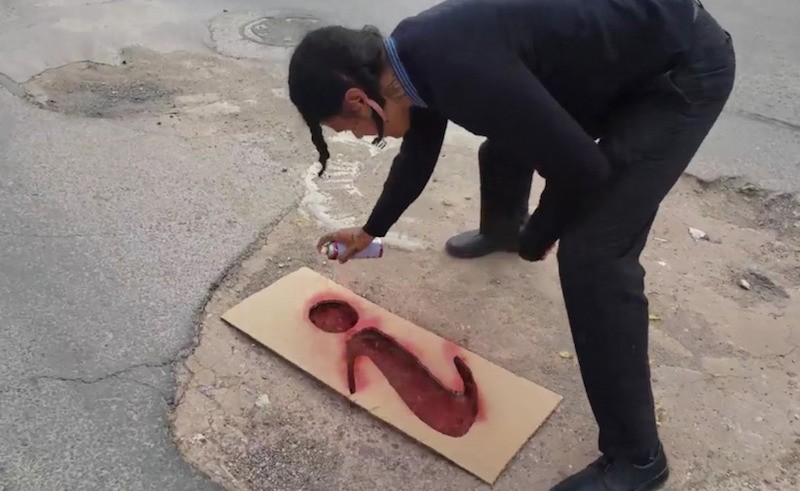
During his tenure as mayor citizens have complained about the sorry conditions of streets throughout the city.  Recently a man who calls himself Maquina de Fuego (Fire Machine) has been spray-painting an "i", about two feet long, in red, directly onto some of the thousands of potholes on streets throughout the city, and has called on other citizens to do the same.  "We are not vandalizing," he says.  "We are simply locating the potholes so that the government won't have to take the trouble to find them."  At a demonstration late last week women threw stuff at the entryway of municipal offices, and Cabada's name has become associated with Bache-Gate, for a variety of reasons.

Maquina de Fuego has a following of 15,000 on his Facebook page and 262,000+ subscribers to his You Tube page, "Amigos de la Llanura."

Left:  image in NorteDigital story (here), of Maquina de Fuego at his artistic best.

Friday, March 6, 2020

UNCTAD BEGINS ESTIMATING LOST TRADE DUE TO COVID-19
FIRST CUT:  $50 BILLION LOSS GLOBALLY SO FAR; MEXICO 8TH MOST AFFECTED ECONOMY

The United Nations Conference on Trade and Development, which tracks global trade, estimates the coronavirus outbreak has cost global value chains $50 billion in lost trade, so far.  Click here for a summary posted by UNCTAD yesterday.

UNCTAD estimates the most affected sectors include precision instruments, machinery, automotive and communication equipment.  According to the report the most affected economies thus far are:  The European Union ($15.6 billion, the US ($5.8 billion), and Japan ($5.2 billion.  Mexico is listed as the eighth most affected economy, with a loss of trade up to now of over $1.3 billion, well ahead of Canada, 12th on the list at $660 million.

Click here for a more detailed set of data.  A chart of sectors affected so far shows Mexico has been hardest hit in the automotive and electric machinery sectors ($493 million and $341 million, respectively.

Click here for data on changes in shipping patterns since the outbreak.

UNCTAD has a long history.  Its first conference was held in 1964, and its first Secretary General was the Argentine economist Raúl Prebisch,  Prebisch was already famous at the time for his scathing critique of the global regime for trade emerging out of World War II which, he claimed, was rigged against developing countries because the terms of trade were unfavorable to countries exporting agricultural and other primary products.  His work inspired the Dependency Theory crafted by Carlos Henrique Cardoso (later to become President of Brazil) and Enzo Faletto, by Teotonio Dos Santos, Oswaldo Sunkel, Andre Gunter Frank, and others.  Another major theorist inspired by Prebisch was Johann Galtung, a mathematician who operationalized much of dependency theory in his influential article, "A Structural Theory of Imperialism."

Thursday, March 5, 2020

Update:  Still no Confirmed Presence of Coronavirus (Covid-19) in Juárez
Update on Other Areas in Latin America

 A Diario report this morning (click here) asserts that two persons in Cd. Juárez are under observation for possible infection of the Covid-19 virus, but are expected to be released shortly, since they have shown no symptoms of the virus.  The two persons in question had traveled to Shanghai, Tokyo, and then Mexico City, and arriving in Juárez on February 21.  Bottom Line:  Thus far there are no known cases of Covid-19 in Cd. Juárez.

Diario also ran an AP story this morning (click here) summarizing the known incidence of the novel coronavirus throughout Latin Ameria. Ecuador has the most cases in all of Latin America, with 13 reported cases so far.  Another 122 are in residential isolation.  A representative of the World Health Organization explained that the 12 most recent cases are "what we call a second scenario; the first confirmed case constituted the direct line of contact; the second scenario cases, fortunately are confined to the familial network ("conglomerado familiar"), passed on from the first case."

The AP story goes on to report the confirmed presence of novel coronavirus cases in Argentina, Brazil, Chile, Mexico, and the Dominican Republic.


Chihuahua State Legislature Will Host Arizona Legislators On Friday

According to a story this morning in El Heraldo de Chihuahua (click here), the president of the Chihuahua legislature, René Frías Bencomo, a state deputy, announced yesterday that a bipartisan delegation of state legislators from Arizona will meet with counterparts on Friday in a special session.  The delegation from Arizona reached out to the president of the Legislature, seeking to improve cross-border collaboration.  A liason office will begin functioning in the near future to stimulate trade and investment and to seek opportunities in the aerospace sector

Wednesday, March 4, 2020

Juárez Coronavirus Test Results Come Out Negative
Chihuahua State, Juárez, Still Coronavirus Free

Good News:  Last night the test results for the 3 persons in Chihuahua who had contracted illness apparently in Italy, came back negative.  Click here for story in Diario.  From the reports, the three persons were infected only with a rhinovirus, like the common cold.

Tuesday, March 3, 2020

Two Persons from Cd. Juarez Being Tested for Coronavirus
Both had recently traveled to Italy
Another Traveler to Italy Being Tested in Chihuahua

Norte Digital (see link on right side of desktop version of LPNM) reports this morning (click here) that samples from three persons from Chihuahua state have been sent to Mexico City for testing.  Two of these are living in Cd. Juárez, another in Chihuahua.  The results of the tests are expected back this morning.  El Heraldo de Chihuahua is more explicit (click here), reporting that the two cases from Juárez have acute respiratory illnesses ("enfermedades respiratorias agudas"), but do not appear to be serious.  The Heraldo story asserts that the persons have had contact with persons who have been in Europe.  Other news sources have stated the persons had traveled to Italy.


Monday, March 2, 2020

Coronavirus and Supply Chains on the US-Mexico Border:
An Interview with Jerry Pacheco, President of the Border Industrial Association

Jose Z. Garcia

After reviewing the news in Cd. Juárez and Mexico City about the potential threat the coronavirus poses to manufacturing on the US-Mexico border, I called Jerry Pacheco, President of the Border Industrial Association at Santa Teresa, for an interview about global supply chains as these affect the border.  Much of the information contained below was derived from sources he generously provided.  To better understand the potential threats from a global pandemic to supply chains in the region, it might be helpful to provide some background information (Part I) before getting to the interview (Part II).  Some readers may wish to skip directly to the interview.

Part I:  Background

The Paso del Norte border crossings—at El Paso and Santa Teresa—import from, and export to, Mexico at the level of about $110 billion in goods per year.  This represents 22% of trade through all land crossings on the US-Mexico border, the value of which is well over $600 billion.  Santa Teresa, the fourth busiest port on the border, imports more than $16 billion (2018 figures) from Mexico and exports over $14 billion of goods to Mexico.  Putting this into comparative perspective, New Mexico’s GDP in 2018 was slightly over $100 billion, in a year of record oil sales.  A lot of value transits through the Paso del Norte, not even counting the value of illegal drug shipments.  El Heraldo de Chihuahua reported yesterday (Sunday) that Cd. Juárez border crossing exports to the USin 2019 reached nearly $67 billion (US), according to Jaime Campos, director of industry in the Chihuahua state Economic Development and Innovation Department, and former director of the New Mexico Border Authority during the Richardson administration.


The Maquila Industry in Cd. Juárez

Who owns the maquila plants?  For many years maquila plants in Juárez were owned by US firms.  No more.  Japanese and German firms combined own 15% of them.  In the interview Pacheco rattled off other owners:  Spain (Siemens-GAMESA); their maquila in Juárez produces the large windmill blades seen on trucks all over New Mexico; China, Britain, France, Canada, Sweden, Taiwan, South Korea, Malaysia.  Together, non-US firms own about 37% of the maquilas in Juárez. (click here for source) Global ownership of these maquilas is now a fact.

Cd. Juárez is the largest maquila producer on the US-Mexico border.  Sixty nine percent of all jobs there (around 310,000 out of a total of about 450,000 jobs) are employed in the manufacturing sector.  (click here for the source).  By comparison, Albuquerque, with less than half the population of Juárez, in 2019 had a civilian labor force of about 440,000, but only about 16,000 of these were in the manufacturing sector.  Juárez has a much younger population than Albuquerque, and family sizes are larger, which is why total employment in each city is about the same. 
Part II

Interview with Jerry Pacheco, President of Borderland Industrial Association
on Potential Effects of Coronavirus on Supply Chains in the US-Mexico Border Region


Pacheco Explains Supply Chains:

Let’s begin with an example posed by Pacheco.  Suppose a large maquila plant in Juárez assembles computers for a well-established firm with global markets, say, in Europe, Australia, and Latin America. The demand for quick shipment to buyers requires rigorous adherence to tight time schedules.  Let us imagine this firm purchases certain plastic components from China.  Other components may come from a computer chip manufacturer, perhaps in Albuquerque; others are produced, say, in Guanajuato, Mexico, while still others are produced in India or other manufacturing centers. The firm assembles parts delivered to the plant in Juárez from warehouses in El Paso, Santa Teresa or Juárez for “just-in-time shipment” of computers on a time schedule that may have a permissible deviation of just a few minutes or hours.  And to save costs, the assembly plant may have an inventory of parts available for its computers that will last only two or three weeks in advance.

Global Pandemics as they affect a maquila in Juárez

To understand the dangers of a global pandemic, Pacheco went on, imagine that an outbreak of a new virus in China (which produces 20% of global manufacturing) causes slowdowns and delays in shipments of vital computer component parts to Juárez, as workers producing these parts in China are quarantined, refuse to go to work, etc.  There are many potential obstacles to replacing these shipments quickly.  It might take weeks or months for the firm to find a suitable supplier to replace the Chinese one.  Proprietary and other business agreements may create legal delays.  Logistical problems linking a new potential supplier to Juárez may raise transportation costs or create more delays.

The delays may have a ripple or cascading effect.  Some workers may be laid off until the supply chain is fixed.  This drop-off of workers will slow down consumer spending in Juárez and across the river in El Paso.  Business investment there will slow down.  The delays in shipping may reduce annual sales to the parent firm, and this might cause some layoffs of workers in other locations servicing different products or markets.  Thus, interruptions of one element in a supply chain for global manufacturers may create slowdowns and tensions cascading throughout the entire chain, and this may include several local economies, causing further economic declines.  Should more than one element in the supply chain be affected, say, after an outbreak of the virus in Albuquerque, this will aggravate production schedules even more.

Add another sector or two, say, television production or auto manufacturing, with interrupted supply chains caused by the virus, and the global economy begins to shrink perceptibly.  (my comment, not Pacheco's) That the stock market lost 12% of its value last week is a cold, objective, and very non-partisan assessment by very bright analysts on Wall Street of the potential risk to revenue generation in global corporate markets over the next few months, should the coronavirus situation break out into a full-scale pandemic.  Right now, Wall Street believes the chances of more bad news is high.  The World Health Organization believes the chances of coronavirus illness becoming more widespread is “very high.”

According to Pacheco, firms at Santa Teresa are closely monitoring the coronavirus issue; many are stocking up on their inventory to avoid delays, should the epidemic in China continue or get worse or spread to other areas that supply maquila plants in Juárez.

At the end of the interview Pacheco suggested that the current supply-chain regime, which is truly global in scope, might be slightly more costly, but more stable, if more regional markets, with regional rather than global supply chains were established.  For example, North America down to Panama might be a regional hub; South America might be another; Southeast Asia, Greater Europe, China, might be others.  Supply chains would be created around certain products, such as auto parts or televisions, or computers, within the region itself, not on a global scale.  While the risk of supply chain disruptions would still exist, they would be contained with one region, with possible replacement of vital elements in one regional chain by those in a different region.

As I recall, this is what was contemplated about 30 years ago, when NAFTA was designed,  This was just before China doubled the global supply of labor by opening its labor markets to global capital, providing corporations with cheap labor, and the global manufacturing rush to China began.

Pacheco also reminded me that the Swine Flu pandemic began in Veracruz, Mexico, in early 2009, and in a short time much of Mexico City had shut down.  The virus spread throughout the globe, with 11%-21% of the population of the world contracting it.  Fortunately the virus was not very lethal, with only around 200,000-300,000 fatalities. By the end of 2010 the disease had subsided.

Friday, February 28, 2020

Juárez:  The Homicide Toll Continues

Diario reports this morning that Juárez has registered 226 homicides so far this year, on track with last year, which registered about 1500 murders.  Albuquerque, with a population less than half the size of Juárez, registered 82 homicides in all of 2019.
Two persons were executed yesterday, (Thursday), one wrapped in blankets ("encobijado"), another was found next to a truck in front of a house.